Book Categories:

Wait, don't go!
Become a Member Today and Unlock Access to All eBooks!
Thousands of eBooks at your fingertips. Read, learn, and grow anytime, anywhere.
Become a Member Today and Unlock Access to All eBooks!
Thousands of eBooks at your fingertips. Read, learn, and grow anytime, anywhere.
Original price was: $129.99.$5.00Current price is: $5.00.
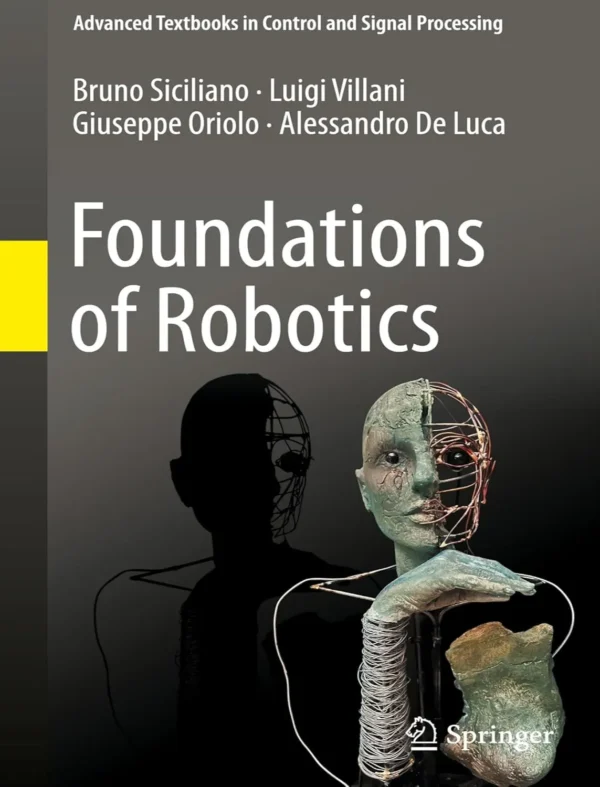
Gain a comprehensive understanding of modern robotics through a rigorous yet accessible exploration of its three fundamental pillars: modeling, planning, and control. Designed to balance mathematical precision with practical engineering insight, this textbook provides a unified framework for analyzing, designing, and implementing robotic systems across a wide range of applications.
Covering both fixed-base robotic manipulators and mobile robotic platforms, the book presents the essential theoretical foundations and practical methodologies required to understand and develop advanced robotic systems in academic and industrial environments.
Develop a solid understanding of robot representation, coordinate transformations, forward and inverse kinematics, and the mathematical tools required to describe robotic motion accurately.
Explore the principles governing robotic forces and motion. Learn how dynamic models are derived and utilized to predict system behavior, optimize performance, and design effective control strategies.
Discover methods for generating smooth, efficient, and collision-free robot trajectories. Study motion planning techniques that enable robots to perform complex tasks in structured and unstructured environments.
Learn the fundamentals of motion control and feedback systems used to achieve precision, stability, and robustness in robotic applications. The book bridges theoretical control concepts with practical implementation techniques.
Building upon the foundational material, the second part of the book explores advanced areas of robotics, including:
These topics provide readers with a deeper understanding of contemporary robotics challenges and the technologies driving modern robotic innovation.
To support students from diverse engineering backgrounds, comprehensive appendices review essential prerequisite topics, including:
These references make the book suitable for both self-study and structured academic coursework.
The book emphasizes real-world implementation and problem-solving through:
A dedicated Solutions Manual is also available for instructors adopting the textbook for university courses.
This textbook is ideal for:
By studying this book, readers will develop a strong foundation in robotic system modeling, motion planning, dynamics, and control while gaining exposure to advanced topics that define the current state of robotics research and development.
Combining rigorous theory, practical implementation, and application-driven examples, Foundations of Robotics serves as an essential resource for anyone seeking a deep and comprehensive understanding of modern robotic systems.

Reviews
There are no reviews yet.