

Wait! Don’t Go Yet! 👋
Become a Member Today and Unlock Access to All eBooks! 😍
Thousands of eBooks at your fingertips. Read, learn, and grow anytime, anywhere ✨
Become a Member Today and Unlock Access to All eBooks! 😍
Thousands of eBooks at your fingertips. Read, learn, and grow anytime, anywhere ✨

ESP-NOW vs. Bluetooth — Choosing the right wireless communication protocol for your ESP32 project can be tough. What are the differences between ESP-NOW and Bluetooth, and which protocol best suits my project’s requirements?
If you are facing the same problem, keep reading this guide, where I explain all the most important differences and help you decide which protocol to use for your next (IoT) project!
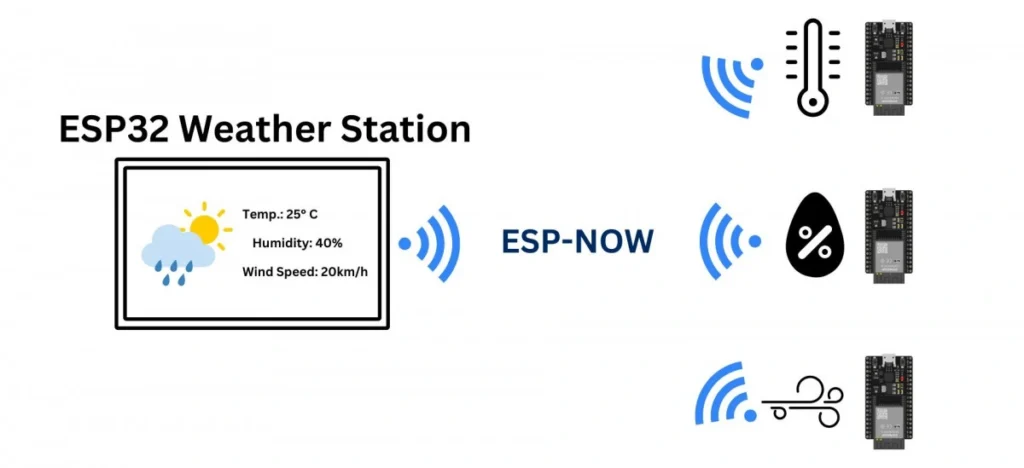
ESP-NOW is a low-power, connectionless communication protocol developed by Espressif and designed specifically for ESP32 and ESP8266 devices. Unlike traditional Wi-Fi or Bluetooth, ESP-NOW allows devices to communicate directly without establishing a formal connection, making it ideal for fast, low-latency data transmission.
If you want to learn more about ESP-NOW, read this article, in which I explain the protocol more thoroughly.
Very often, ESP-NOW is used by hobbyists to transfer smaller data packets between ESP microcontrollers without the need for a complex setup.
For instance, sensors that track the environment often use ESP-NOW to send the data over to a central ESP32 or ESP2866 control unit.
Another example is using ESP-NOW to build a wireless remote controller to control an ESP32-based game console, an RC car, etc.
Top 6
ESP32 eBooks
From Zero to Professional

Probably, you already know Bluetooth. It is a universal wireless protocol widely used in consumer electronics. The ESP32 supports both Bluetooth Classic and Bluetooth Low Energy (BLE).
Bluetooth Classic is designed for continuous, high-data-rate applications like audio streaming (e.g., wireless headphones), resulting in higher power consumption and longer range. Bluetooth Low Energy (BLE), on the other hand, is optimized for low-power data transfers with lower data rates and is ideal for devices that need to conserve battery life (e.g., smart home sensors).
Bluetooth is used where devices need to be paired to smartphones or other third-party devices, like Bluetooth speakers.
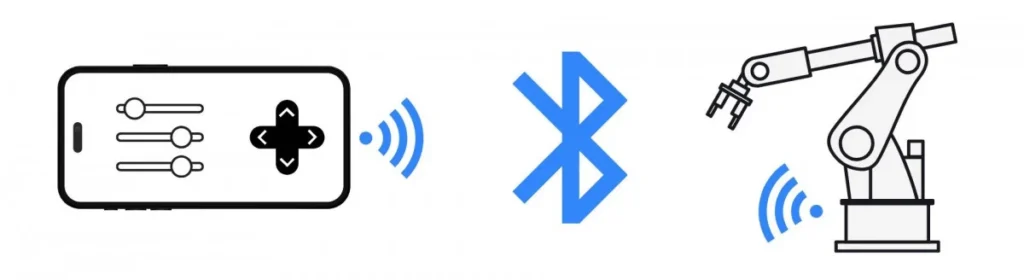
For example, you could build an app-controlled robot that pairs with your phone via Bluetooth.
Another example is building your own Bluetooth speaker that requires a higher data bandwidth compared to ESP-NOW.
| Feature | ESP-NOW | Bluetooth (BLE/Classic) |
|---|---|---|
| Range | Up to 200m in open fields | 10-50m BLE, up to 100m Classic |
| Power Consumption | Very low, ideal for continuous communication | Low for BLE, higher for Classic |
| Data Transfer Speed | Fast, suitable for small packets | Fast for BLE, even faster for Classic |
| Network Structure | One-to-many, many-to-one, many-to-many (peer-to-peer) | One-to-one (Classic), mesh (BLE) |
| Compatibility | ESP32 and ESP8266 devices only | Universally supported on many devices |
| Security | Supports CCMP encryption | Standard encryption protocols for both types |
| Reliability | High, with retransmission, CRC checks, and ACKs | Very reliable with frequency hopping (Classic) and error correction |
Bluetooth is more versatile for broader, well-established use cases and offers high compatibility with various devices. ESP-NOW, on the other hand, is more specialized and optimized for direct communication between ESP microcontrollers with low power consumption and low latency, typically in IoT and sensor networks.
Let’s dive a bit deeper into some of the points from the table:
With 200 meters, ESP-NOW has about double the range of classic Bluetooth when used in an open environment. Even if you don’t need that big of a range, ESP-NOW can transfer data more reliably in a crowded environment with many obstacles.
Because of its universal support, Bluetooth is used in many consumer applications. You know Bluetooth from your phone, headphones, watch, and many other consumer electronic devices. ESP-NOW, however, is only supported by the ESP32 and ESP8266 microcontrollers, making it less suitable for pairing with various devices. Thus, its use cases are more specific (e.g., smart home sensors).
Top 6
Arduino eBooks
From Zero to Professional

Both protocols offer standardized encryption, but ESP-NOW’s peer-to-peer encryption has a slight edge over Bluetooth because there is no pairing and bonding mechanism. This reduces the risk of man-in-the-middle (MITM) attacks and misconfigured devices.
If you want to learn more about the encryption of ESP-NOW, read this article, in which I explain how to send encrypted messages with ESP-NOW.
I have created a little guideline for you to follow when choosing a wireless protocol for your next (IoT) project.
Both ESP-NOW and Bluetooth have their strengths and are suited for different types of projects. If you need long-range, power-efficient, low-latency communication between ESP devices, ESP-NOW is your best bet. However, if you require universal compatibility with smartphones and other devices or need higher data rates for applications like audio streaming, Bluetooth is the way to go
Do you have experience using ESP-NOW or Bluetooth in your IoT projects? Share your thoughts in the comments below!
Thanks for reading!
🚀 Discover the world of electronics and innovation!
✨ Create, program, and experiment with all your creative ideas with ease.
🔥 Don't wait! Browse SpotPear products now and start your amazing project!