Book Categories:


Wait, don't go!
Become a Member Today and Unlock Access to All eBooks!
Thousands of eBooks at your fingertips. Read, learn, and grow anytime, anywhere.
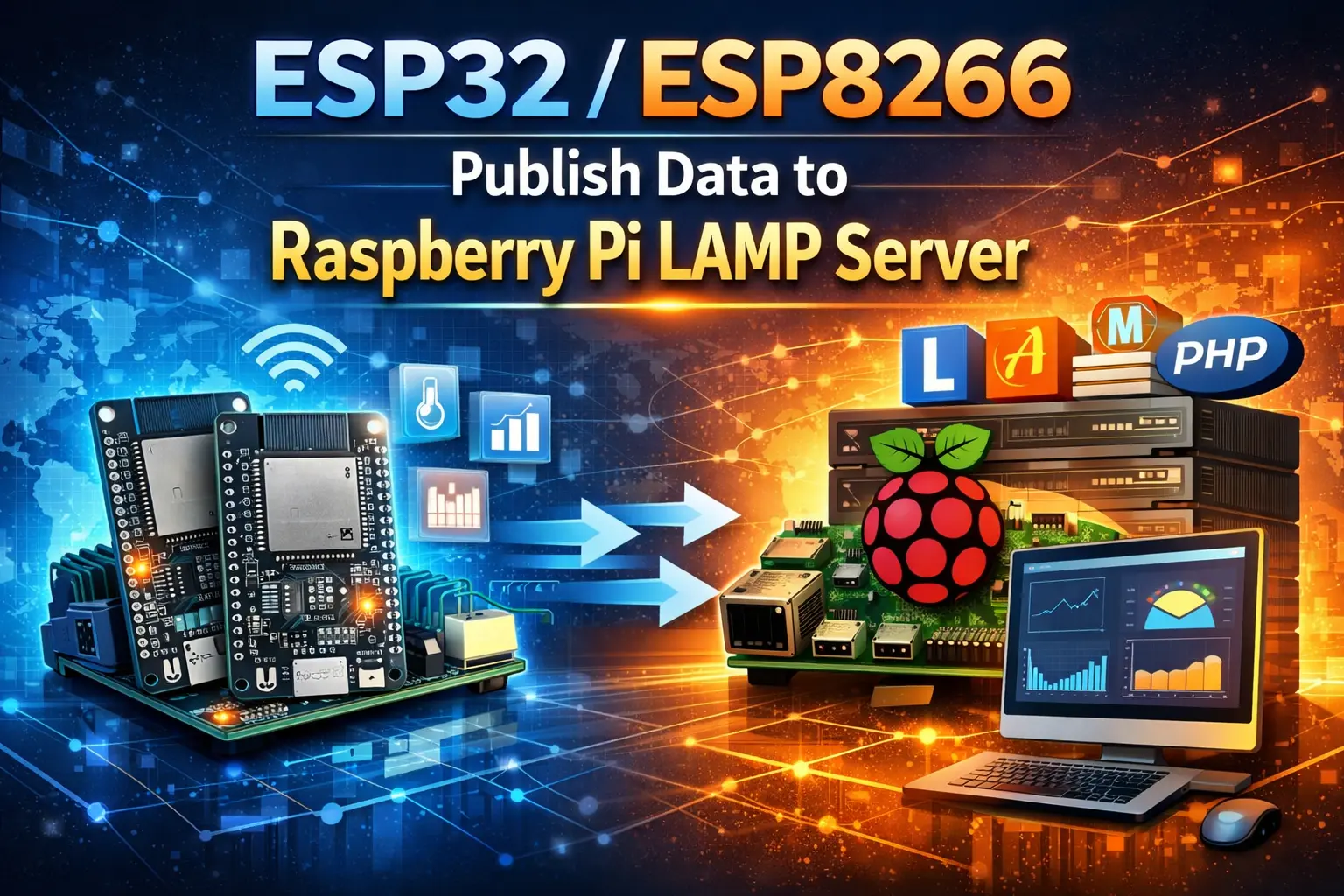
In this project, you’ll build an ESP32 or ESP8266 client that makes an HTTP POST request to a Raspberry Pi LAMP server (Linux, Apache, MySQL, PHP). The Raspberry Pi has a PHP script to insert data (sensor readings) into a MySQL database.
You’ll also have a web page that displays the sensor readings, timestamps, and other information stored in the database. You can visualize your data locally from any browser in your network.
Note: you can make this project accessible from anywhere in the world follow this project.
As an example, we’ll be using a BME280 sensor connected to an ESP board. You can modify the code provided to send readings from a different sensor or use multiple boards.
To build this project, you’ll use these technologies:
Before continuing with this tutorial:
After having your Raspberry Pi board prepared with Raspbian OS and a LAMP server, you can continue with this tutorial.


The goal of this project is to have your Raspberry Pi running a LAMP server that allows you to store sensor readings from the ESP32 or ESP8266. You can visualize the readings from any browser in your local network.
Here’s a high-level overview:
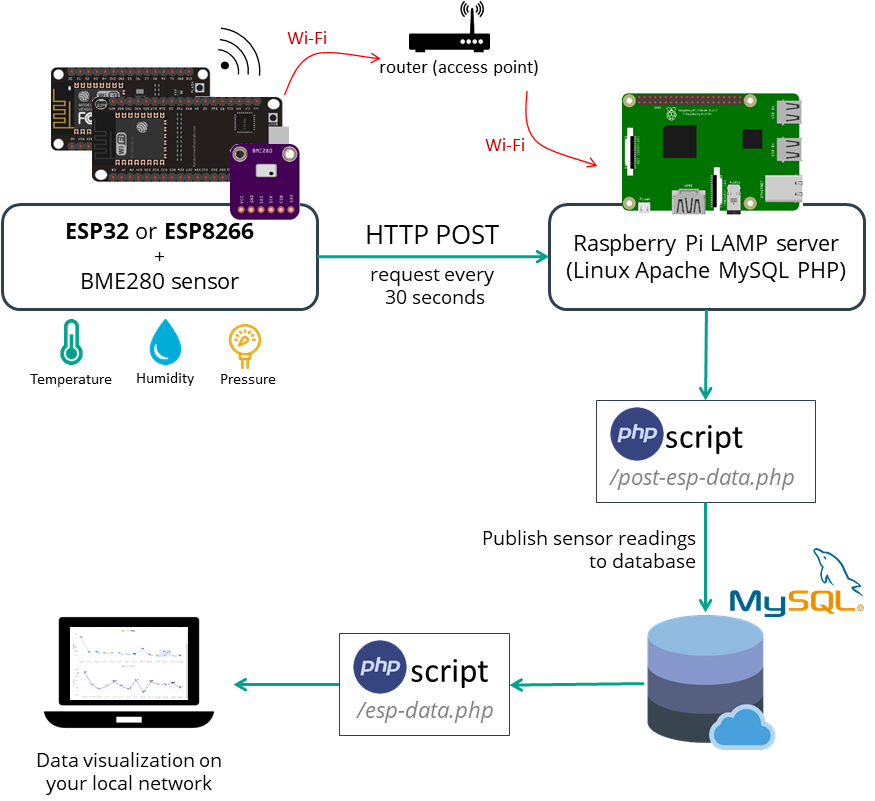
After installing a LAMP server and phpMyAdmin on Raspberry Pi, you can login to phpMyAdmin. After that, follow the next steps to create your database and SQL table.
Open your browser and type http://Your-Raspberry-Pi-IP-Address/phpmyadmin), you should see the login page for phpMyAdmin web interface.
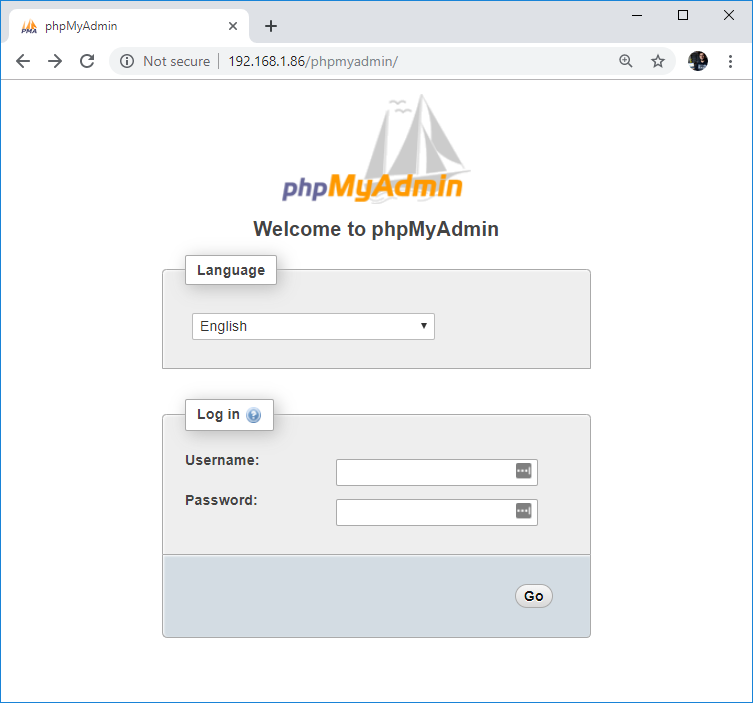
After login, you should see a similar page:
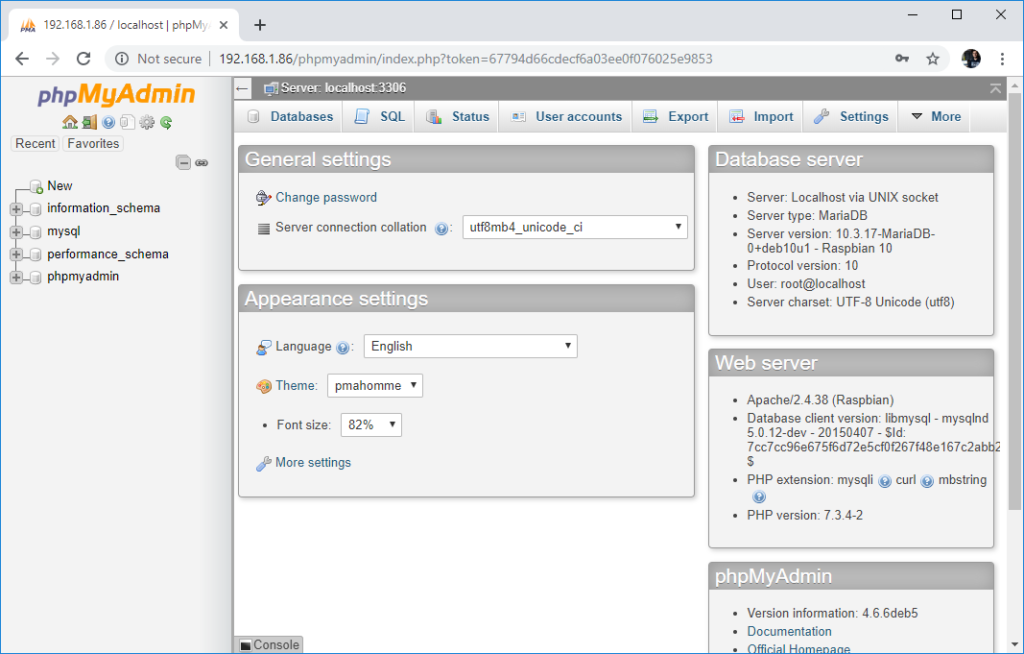
1. Select the “Databases” menu at the top, complete the “Create database” fields:
Then, press the Create button:
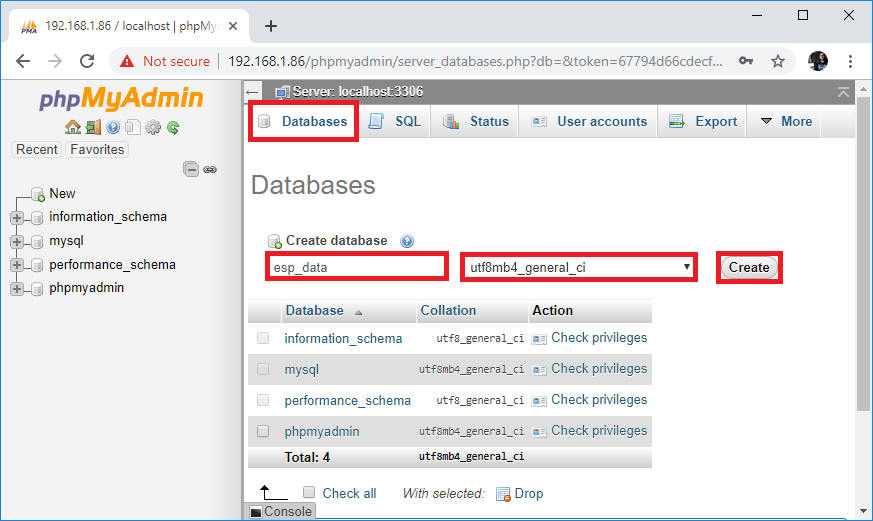

That’s it! Your new database was created successfully. Now, save your database name because you’ll need it later:
After creating your database, in the left sidebar, select your database name esp_data:
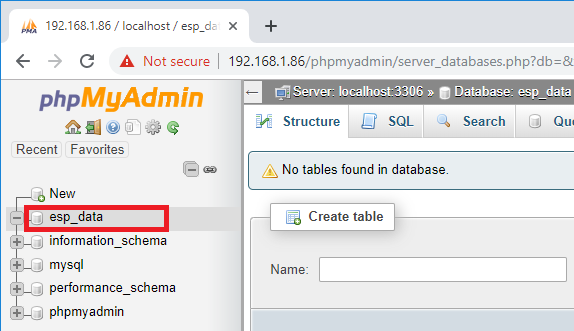
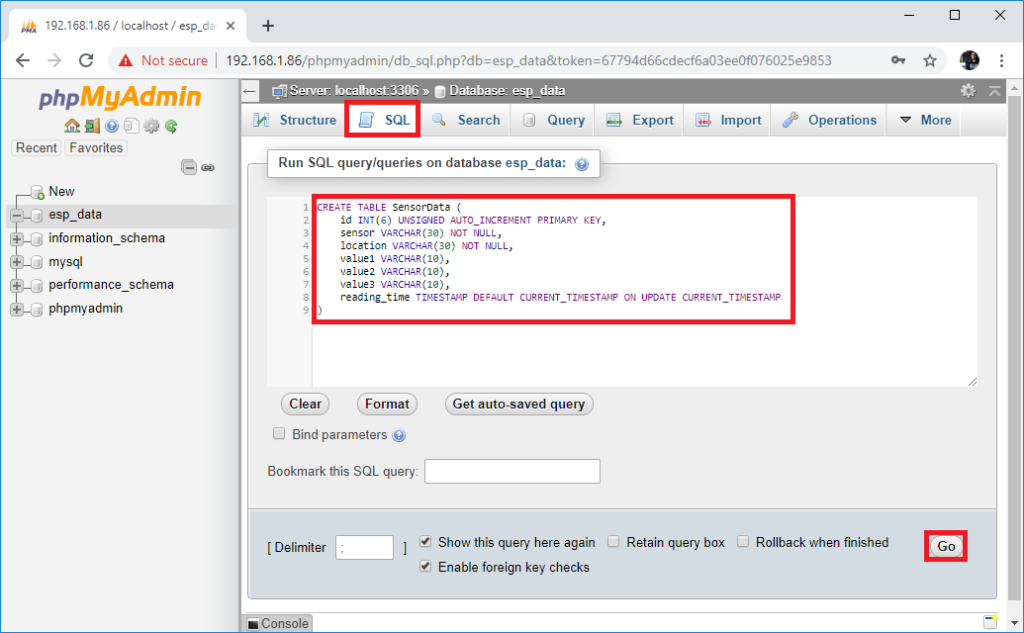
Important: Make sure you’ve opened the esp_data database. Then, click the SQL tab. If you don’t follow these exact steps and run the SQL query, you might create a table in the wrong database.
Copy the SQL query in the following snippet:
CREATE TABLE SensorData (
    id INT(6) UNSIGNED AUTO_INCREMENT PRIMARY KEY,
    sensor VARCHAR(30) NOT NULL,
    location VARCHAR(30) NOT NULL,
    value1 VARCHAR(10),
    value2 VARCHAR(10),
    value3 VARCHAR(10),
    reading_time TIMESTAMP DEFAULT CURRENT_TIMESTAMP ON UPDATE CURRENT_TIMESTAMP
)
Open the “SQL” tab, paste it in the SQL query field (highlighted with a red rectangle), and press the Go button to create your table:
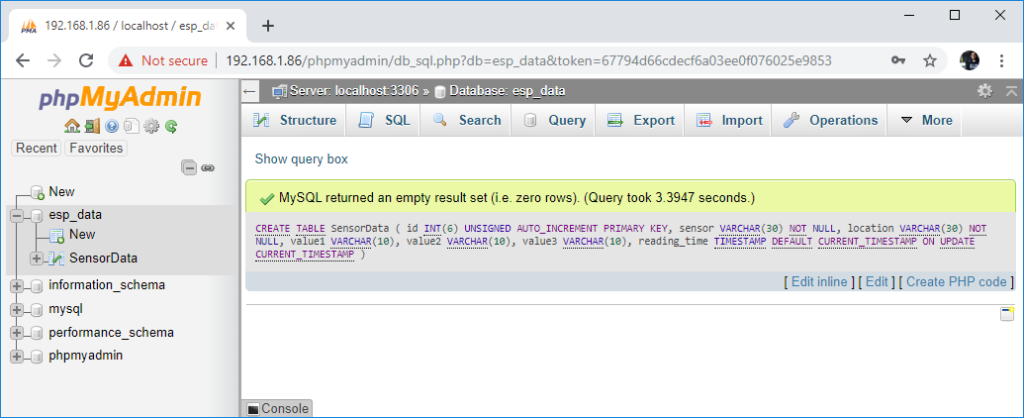
This should appear if your table was created successfully:
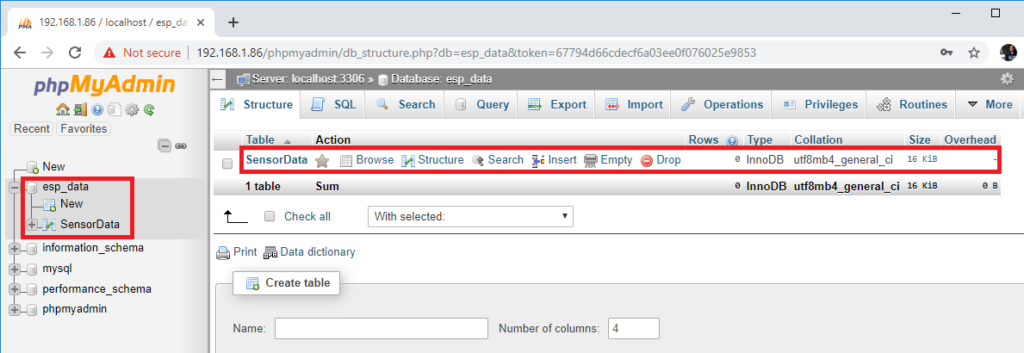
After that, you should see your newly created table called SensorData in the esp_data database as shown in the figure below:
In this section, we’re going to create a PHP script that is responsible for receiving incoming requests from the ESP32 or ESP8266 and inserting the data into a MySQL database.
You can either run the next commands on a Raspberry Pi set as a desktop computer or using an SSH connection.
If you’re connected to your Raspberry Pi with an SSH connection, type the next command to create a file in /var/www/html directory:
pi@raspberrypi:~ $ nano /var/www/html/post-esp-data.php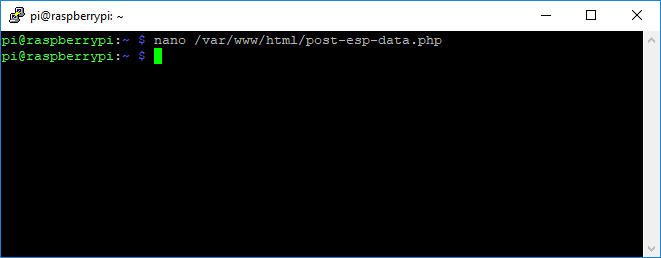
Note: if you’re following this tutorial and you’re not familiar with PHP or MySQL, I recommend creating these exact files. Otherwise, you’ll need to modify the ESP sketch provided with different URL paths.
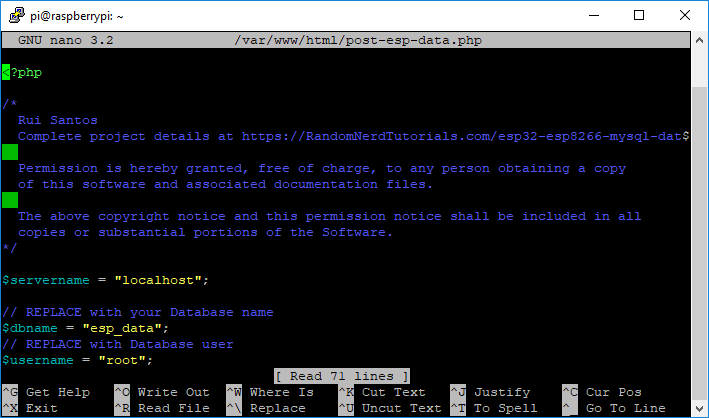
Copy the following PHP script to the newly created file (post-esp-data.php):
<?php

/*
  Ebokify
  Complete project details at https://ebokify.com/esp32-esp8266-mysql-database-php/

  Permission is hereby granted, free of charge, to any person obtaining a copy
  of this software and associated documentation files.

  The above copyright notice and this permission notice shall be included in all
  copies or substantial portions of the Software.
*/

$servername = "localhost";

// REPLACE with your Database name
$dbname = "REPLACE_WITH_YOUR_DATABASE_NAME";
// REPLACE with Database user
$username = "REPLACE_WITH_YOUR_USERNAME";
// REPLACE with Database user password
$password = "REPLACE_WITH_YOUR_PASSWORD";

// Keep this API Key value to be compatible with the ESP32 code provided in the project page.
// If you change this value, the ESP32 sketch needs to match
$api_key_value = "tPmAT5Ab3j7F9";

$api_key= $sensor = $location = $value1 = $value2 = $value3 = "";

if ($_SERVER["REQUEST_METHOD"] == "POST") {
    $api_key = test_input($_POST["api_key"]);
    if($api_key == $api_key_value) {
        $sensor = test_input($_POST["sensor"]);
        $location = test_input($_POST["location"]);
        $value1 = test_input($_POST["value1"]);
        $value2 = test_input($_POST["value2"]);
        $value3 = test_input($_POST["value3"]);

        // Create connection
        $conn = new mysqli($servername, $username, $password, $dbname);
        // Check connection
        if ($conn->connect_error) {
            die("Connection failed: " . $conn->connect_error);
        }

        $sql = "INSERT INTO SensorData (sensor, location, value1, value2, value3)
        VALUES ('" . $sensor . "', '" . $location . "', '" . $value1 . "', '" . $value2 . "', '" . $value3 . "')";

        if ($conn->query($sql) === TRUE) {
            echo "New record created successfully";
        }
        else {
            echo "Error: " . $sql . "<br>" . $conn->error;
        }

        $conn->close();
    }
    else {
        echo "Wrong API Key provided.";
    }

}
else {
    echo "No data posted with HTTP POST.";
}

function test_input($data) {
    $data = trim($data);
    $data = stripslashes($data);
    $data = htmlspecialchars($data);
    return $data;
}
Before saving the file, you need to modify the $dbname, $username, and $password variables with your unique details:
// Your Database name
$dbname = "esp_data";
// Your Database user
$username = "root";
// Your Database user password
$password = "YOUR_USER_PASSWORD";
After adding the database name, username, and password, save the file (Ctrl+X, y, and Enter key) and continue with this tutorial.
If you try to access your RPi IP address in the next URL path, you’ll see the following:
http://You-Raspberry-Pi-IP-Address/post-esp-data.php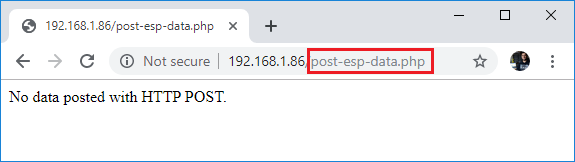
Create another PHP file in the /var/www/html directory that will display all the database content in a web page. Name your new file: esp-data.php
pi@raspberrypi:~ $ nano /var/www/html/esp-data.php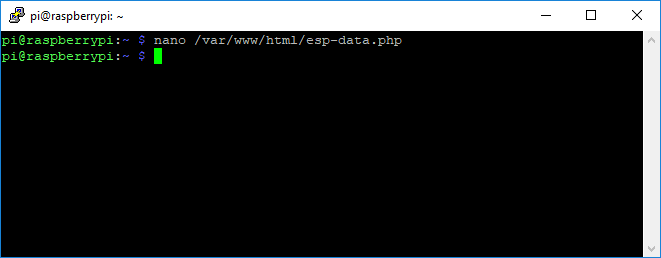
Edit the newly created file (esp-data.php) and copy the following PHP script:
<!DOCTYPE html>
<html><body>
<?php
/*
  Ebokify
  Complete project details at https://ebokify.com/esp32-esp8266-mysql-database-php/

  Permission is hereby granted, free of charge, to any person obtaining a copy
  of this software and associated documentation files.

  The above copyright notice and this permission notice shall be included in all
  copies or substantial portions of the Software.
*/

$servername = "localhost";

// REPLACE with your Database name
$dbname = "REPLACE_WITH_YOUR_DATABASE_NAME";
// REPLACE with Database user
$username = "REPLACE_WITH_YOUR_USERNAME";
// REPLACE with Database user password
$password = "REPLACE_WITH_YOUR_PASSWORD";

// Create connection
$conn = new mysqli($servername, $username, $password, $dbname);
// Check connection
if ($conn->connect_error) {
    die("Connection failed: " . $conn->connect_error);
}

$sql = "SELECT id, sensor, location, value1, value2, value3, reading_time FROM SensorData ORDER BY id DESC";

echo '<table cellspacing="5" cellpadding="5">
      <tr>
        <td>ID</td>
        <td>Sensor</td>
        <td>Location</td>
        <td>Value 1</td>
        <td>Value 2</td>
        <td>Value 3</td>
        <td>Timestamp</td>
      </tr>';

if ($result = $conn->query($sql)) {
    while ($row = $result->fetch_assoc()) {
        $row_id = $row["id"];
        $row_sensor = $row["sensor"];
        $row_location = $row["location"];
        $row_value1 = $row["value1"];
        $row_value2 = $row["value2"];
        $row_value3 = $row["value3"];
        $row_reading_time = $row["reading_time"];
        // Uncomment to set timezone to - 1 hour (you can change 1 to any number)
        //$row_reading_time = date("Y-m-d H:i:s", strtotime("$row_reading_time - 1 hours"));

        // Uncomment to set timezone to + 4 hours (you can change 4 to any number)
        //$row_reading_time = date("Y-m-d H:i:s", strtotime("$row_reading_time + 4 hours"));

        echo '<tr>
                <td>' . $row_id . '</td>
                <td>' . $row_sensor . '</td>
                <td>' . $row_location . '</td>
                <td>' . $row_value1 . '</td>
                <td>' . $row_value2 . '</td>
                <td>' . $row_value3 . '</td>
                <td>' . $row_reading_time . '</td>
              </tr>';
    }
    $result->free();
}

$conn->close();
?>
</table>
</body>
</html>
Add the $dbname, $username and $password:
// Your Database name
$dbname = "esp_data";
// Your Database user
$username = "root";
// Your Database user password
$password = "YOUR_USER_PASSWORD";
Save the file (Ctrl+X, y, and Enter key) and continue with this project.

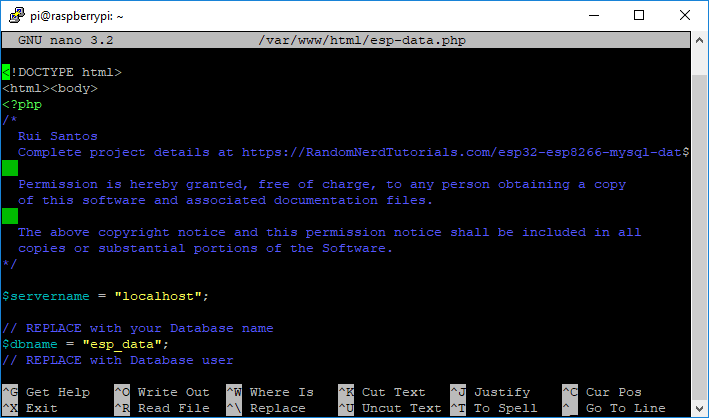
If you try to access your Raspberry Pi IP Address in the following URL path, you’ll see the following:
http://Your-Raspberry-Pi-IP-Address/esp-data.php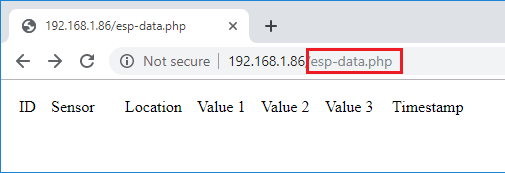
That’s it! If you see that empty table printed in your browser, it means that everything is ready. In the next section, you’ll learn how to insert data from your ESP32 or ESP8266 into the database.
This project is compatible with both the ESP32 and ESP8266 boards. You just need to assemble a simple circuit and upload the sketch provided to insert temperature, humidity, pressure, and more into your database every 30 seconds.
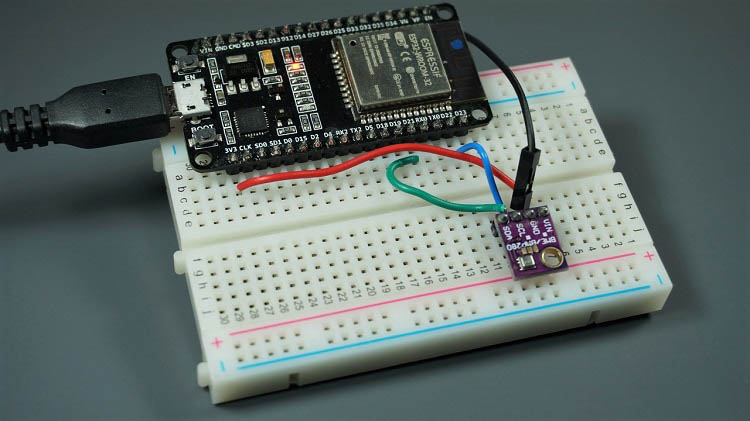
For this example, we’ll get sensor readings from the BME280 sensor. Here’s a list of parts you need to build the circuit for this project:
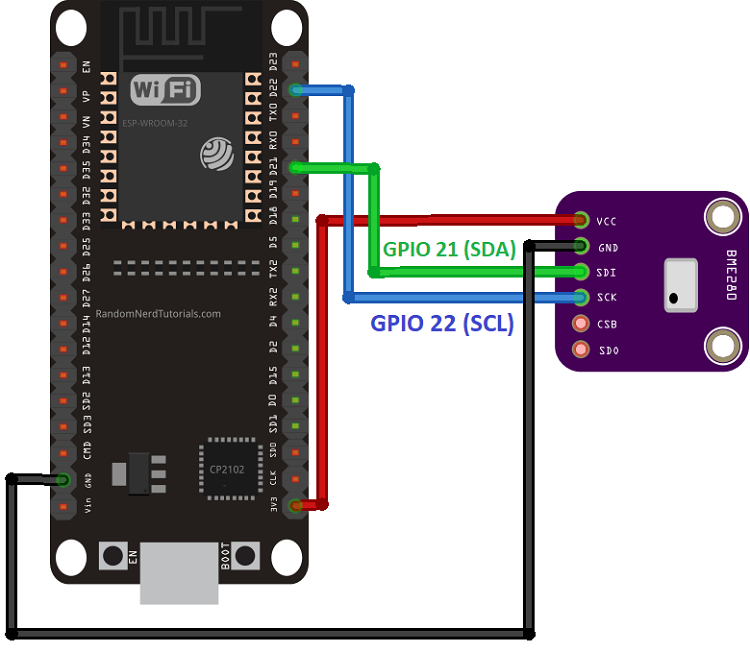
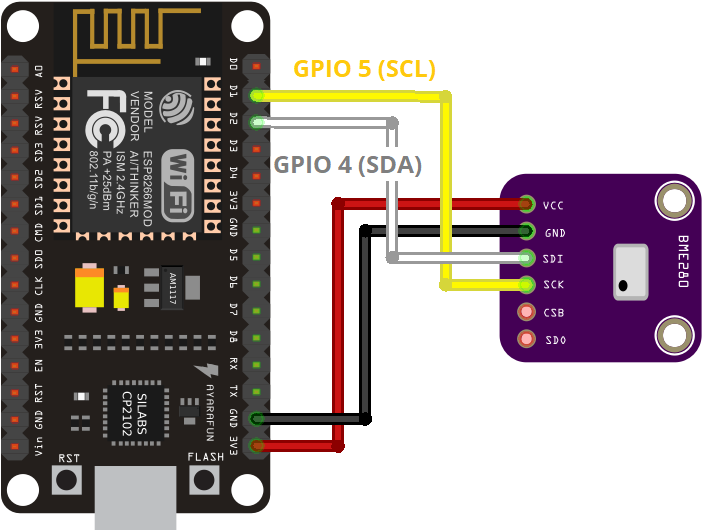
The BME280 sensor module we’re using communicates via I2C communication protocol, so you need to connect it to the ESP32 or ESP8266 I2C pins.
The ESP32 I2C pins are:
The ESP8266 I2C pins are:
After installing the necessary board add-ons, copy the following code to your Arduino IDE, but don’t upload it yet. You need to make some changes to make it work for you.
/*
  Ebokify
  Complete project details at https://ebokify.com/esp32-esp8266-mysql-database-php/

  Permission is hereby granted, free of charge, to any person obtaining a copy
  of this software and associated documentation files.

  The above copyright notice and this permission notice shall be included in all
  copies or substantial portions of the Software.

*/

#ifdef ESP32
  #include <WiFi.h>
  #include <HTTPClient.h>
#else
  #include <ESP8266WiFi.h>
  #include <ESP8266HTTPClient.h>
  #include <WiFiClient.h>
#endif

#include <Wire.h>
#include <Adafruit_Sensor.h>
#include <Adafruit_BME280.h>

// Replace with your network credentials
const char* ssid     = "REPLACE_WITH_YOUR_SSID";
const char* password = "REPLACE_WITH_YOUR_PASSWORD";

// REPLACE with your Domain name and URL path or IP address with path
const char* serverName = "http://example.com/post-esp-data.php";

// Keep this API Key value to be compatible with the PHP code provided in the project page.
// If you change the apiKeyValue value, the PHP file /post-esp-data.php also needs to have the same key
String apiKeyValue = "tPmAT5Ab3j7F9";

String sensorName = "BME280";
String sensorLocation = "Office";

/*#include <SPI.h>
#define BME_SCK 18
#define BME_MISO 19
#define BME_MOSI 23
#define BME_CS 5*/

#define SEALEVELPRESSURE_HPA (1013.25)

Adafruit_BME280 bme;  // I2C
//Adafruit_BME280 bme(BME_CS);  // hardware SPI
//Adafruit_BME280 bme(BME_CS, BME_MOSI, BME_MISO, BME_SCK);  // software SPI

void setup() {
  Serial.begin(115200);

  WiFi.begin(ssid, password);
  Serial.println("Connecting");
  while(WiFi.status() != WL_CONNECTED) {
    delay(500);
    Serial.print(".");
  }
  Serial.println("");
  Serial.print("Connected to WiFi network with IP Address: ");
  Serial.println(WiFi.localIP());

  // (you can also pass in a Wire library object like &Wire2)
  bool status = bme.begin(0x76);
  if (!status) {
    Serial.println("Could not find a valid BME280 sensor, check wiring or change I2C address!");
    while (1);
  }
}

void loop() {
  //Check WiFi connection status
  if(WiFi.status()== WL_CONNECTED){
    WiFiClient client;
    HTTPClient http;

    // Your Domain name with URL path or IP address with path
    http.begin(client, serverName);

    // Specify content-type header
    http.addHeader("Content-Type", "application/x-www-form-urlencoded");

    // Prepare your HTTP POST request data
    String httpRequestData = "api_key=" + apiKeyValue + "&sensor=" + sensorName
                          + "&location=" + sensorLocation + "&value1=" + String(bme.readTemperature())
                          + "&value2=" + String(bme.readHumidity()) + "&value3=" + String(bme.readPressure()/100.0F) + "";
    Serial.print("httpRequestData: ");
    Serial.println(httpRequestData);

    // You can comment the httpRequestData variable above
    // then, use the httpRequestData variable below (for testing purposes without the BME280 sensor)
    //String httpRequestData = "api_key=tPmAT5Ab3j7F9&sensor=BME280&location=Office&value1=24.75&value2=49.54&value3=1005.14";

    // Send HTTP POST request
    int httpResponseCode = http.POST(httpRequestData);

    // If you need an HTTP request with a content type: text/plain
    //http.addHeader("Content-Type", "text/plain");
    //int httpResponseCode = http.POST("Hello, World!");

    // If you need an HTTP request with a content type: application/json, use the following:
    //http.addHeader("Content-Type", "application/json");
    //int httpResponseCode = http.POST("{\"value1\":\"19\",\"value2\":\"67\",\"value3\":\"78\"}");

    if (httpResponseCode>0) {
      Serial.print("HTTP Response code: ");
      Serial.println(httpResponseCode);
    }
    else {
      Serial.print("Error code: ");
      Serial.println(httpResponseCode);
    }
    // Free resources
    http.end();
  }
  else {
    Serial.println("WiFi Disconnected");
  }
  //Send an HTTP POST request every 30 seconds
  delay(30000);
}You need to modify the following lines with your network credentials: SSID and password. The code is well commented on, where you should make the changes.
// Replace with your network credentials
const char* ssid     = "REPLACE_WITH_YOUR_SSID";
const char* password = "REPLACE_WITH_YOUR_PASSWORD";You also need to type your Raspberry Pi IP address, so the ESP publishes the readings to your LAMP server.
const char* serverName = "http://Your-Raspberry-Pi-IP-Address/post-esp-data.php";For example:
const char* serverName = "http://192.168.1.86/post-esp-data.php";Now, you can upload the code to your board. It should work straight away on both the ESP32 and ESP8266 board. If you want to learn how the code works, read the next section.
This project is already quite long, so we won’t cover in detail how the code works, but here’s a quick summary:
apiKeyValue, sensorName, sensorLocation)apiKeyValue is just a random string that you can modify. It’s used for security reasons, so only anyone who knows your API key can publish data to your databaseThen, in the loop() is where you actually make the HTTP POST request every 30 seconds with the latest BME280 readings:
// Your Domain name with URL path or IP address with path
http.begin(serverName);

// Specify content-type header
http.addHeader("Content-Type", "application/x-www-form-urlencoded");

// Prepare your HTTP POST request data
String httpRequestData = "api_key=" + apiKeyValue + "&sensor=" + sensorName                      + "&location=" + sensorLocation + "&value1=" + String(bme.readTemperature())                      + "&value2=" + String(bme.readHumidity()) + "&value3=" + String(bme.readPressure()/100.0F) + "";

int httpResponseCode = http.POST(httpRequestData);
You can comment the httpRequestData variable above that concatenates all the BME280 readings and uses the httpRequestData variable below for testing purposes:
String httpRequestData = "api_key=tPmAT5Ab3j7F9&sensor=BME280&location=Office&value1=24.75&value2=49.54&value3=1005.14";After completing all the steps, let your ESP board collect some readings and publish them to your server.
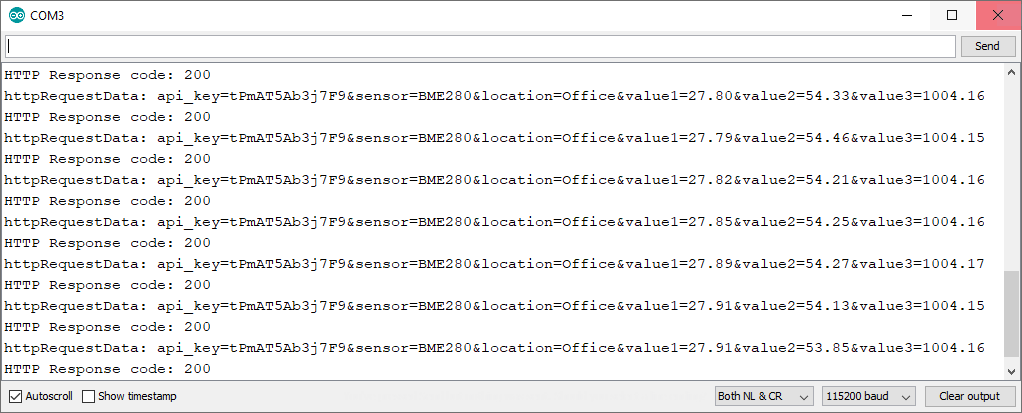
If everything is correct, this is what you should see in your Arduino IDE Serial Monitor:
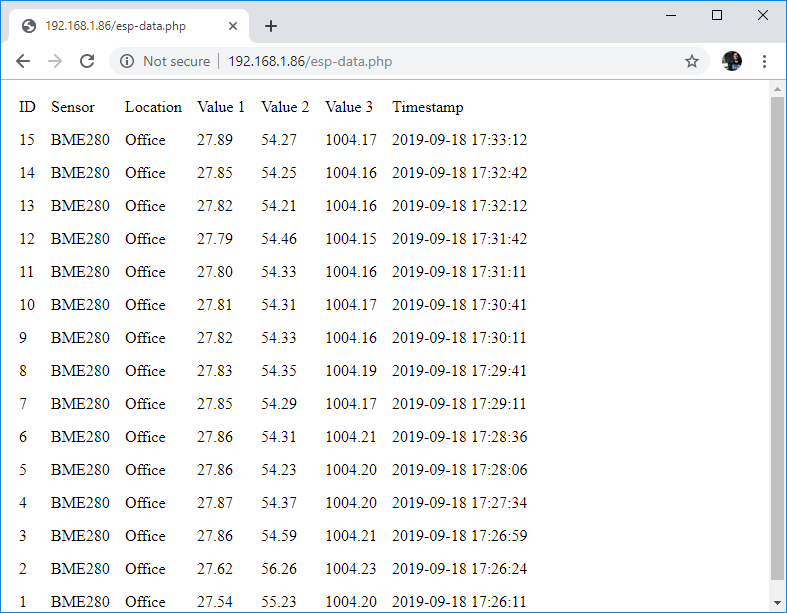
If you open your Raspberry Pi IP address in this URL path /esp-data.php:
http://Your-Raspberry-Pi-IP-Address/esp-data.phpYou should see all the readings stored in your database. Refresh the web page to see the latest readings:
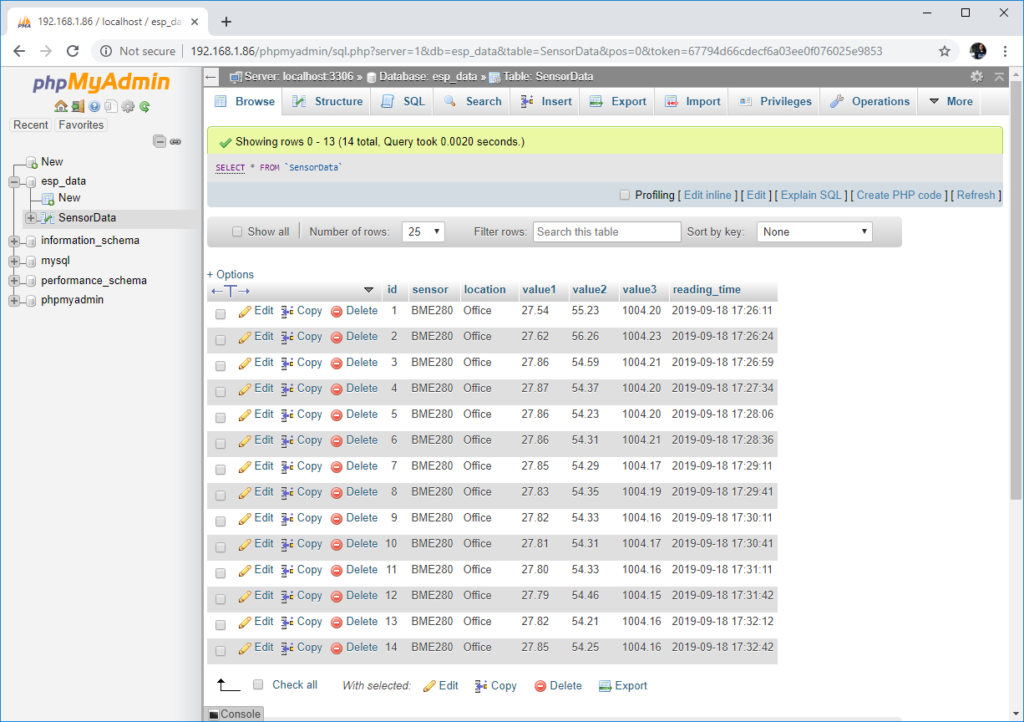
You can also go to phpMyAdmin to manage the data stored in your SensorData table. You can delete it, edit, etc…
In this tutorial, you’ve learned how to publish sensor data into a database in your own local Raspberry Pi LAMP server.
The example provided is as simple as possible so that you can understand how everything works. After understanding this example, you may change the appearance of the table, publish different sensor readings, publish from multiple ESP boards, and much more.
I hope you liked this project. If you have any questions, post a comment below, and we’ll try to get back to you.